The next wave is not just building custom software for workflows. It is building custom intelligence around the way a business thinks, decides, acts, and learns.
For decades, custom software helped businesses digitize the way they operate.
It turned paper forms into databases. It moved approvals into workflows. It gave teams dashboards, portals, CRMs, project boards, analytics platforms, and internal tools. It made work easier to track, easier to assign, and easier to repeat.
That mattered. Custom software helped companies operate.
But the next advantage is different.
The next advantage will not come from owning more tools. It will come from connecting the intelligence between them.
That is the shift Semantic OS is built around: from custom software to custom intelligence.
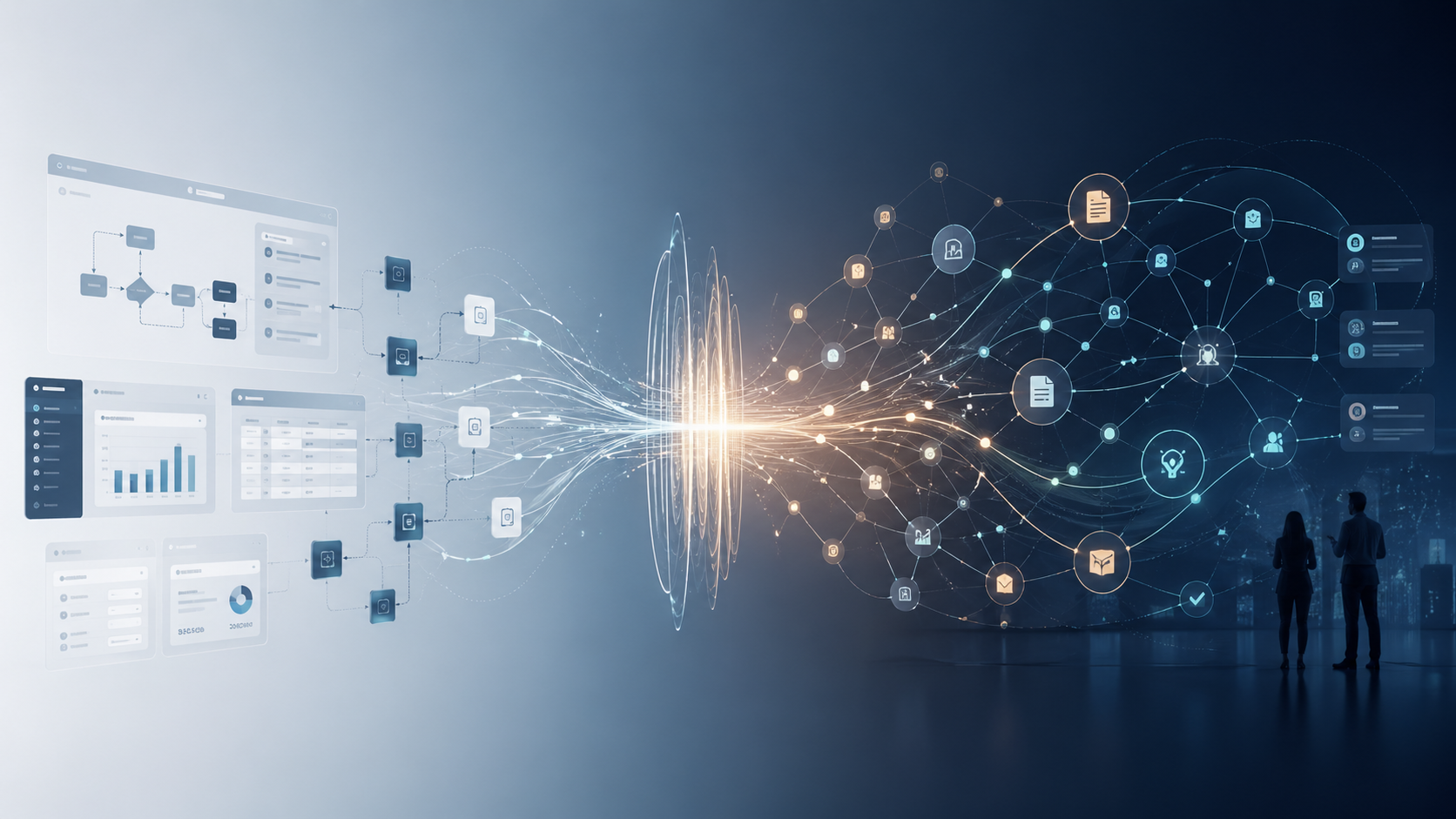
Custom software helps a business operate. Custom intelligence helps a business think.
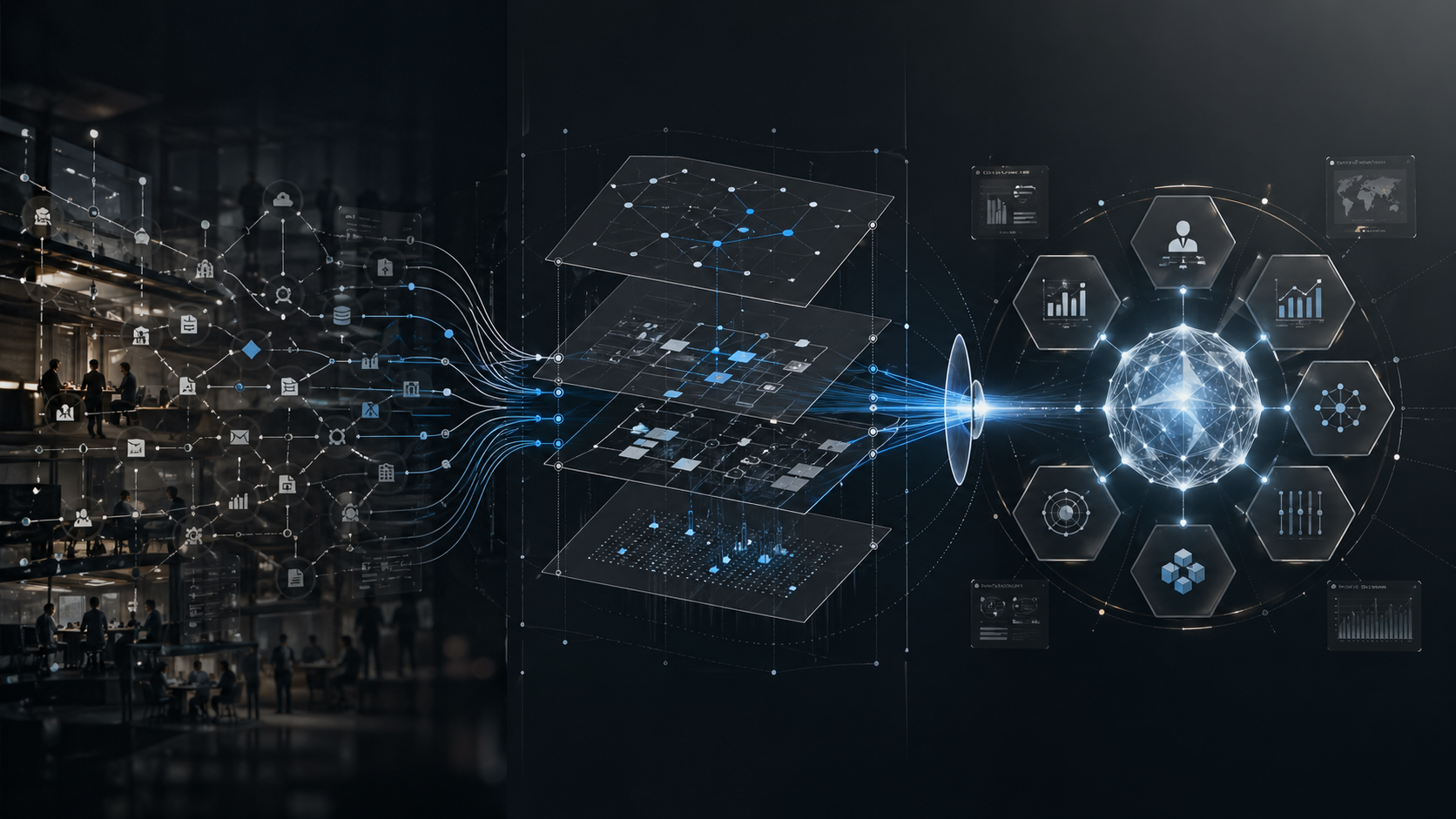
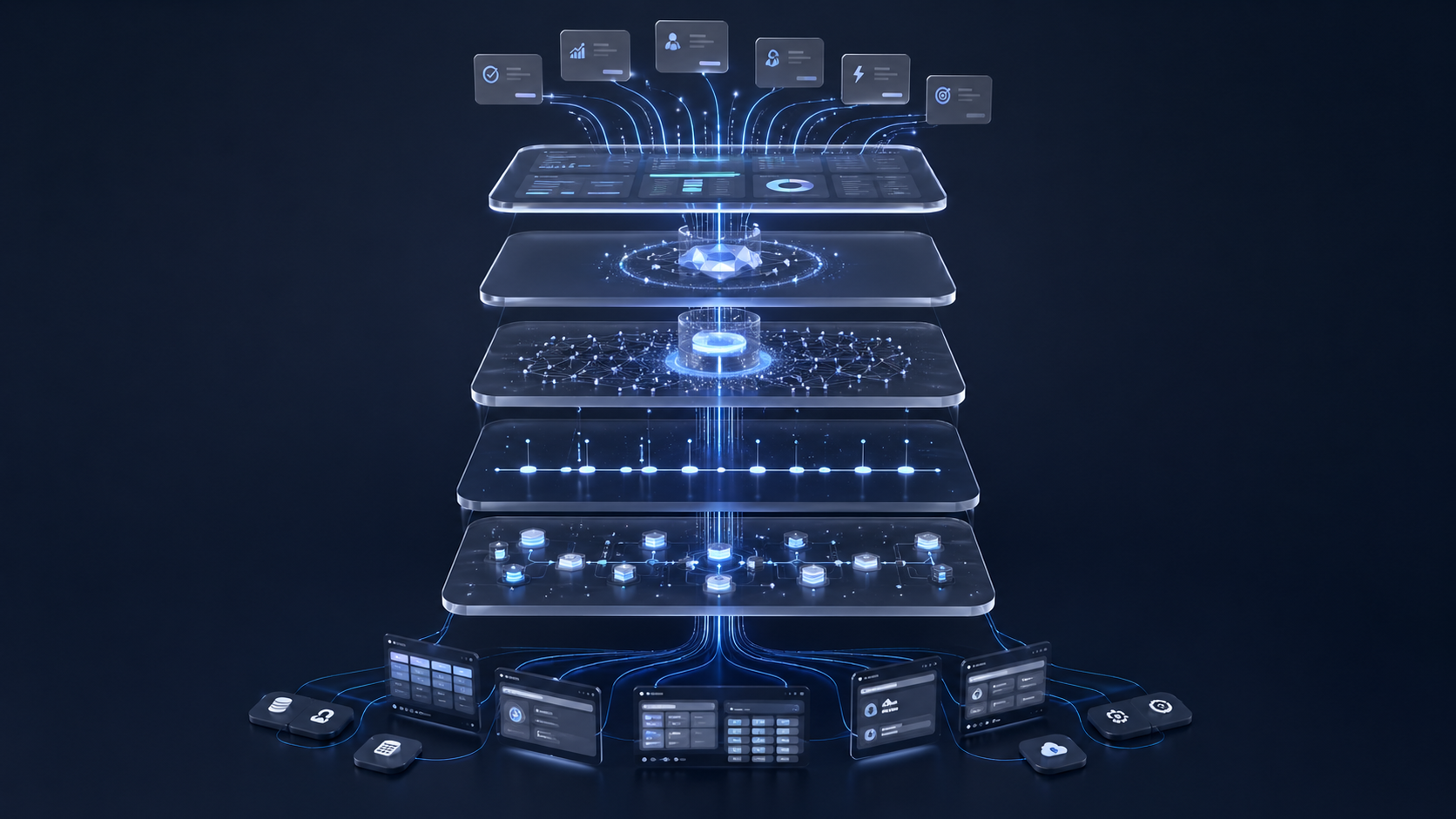
A custom intelligence layer does not simply digitize a process or display information inside another interface. It sits above and between the systems a company already uses. It connects data, workflows, decisions, actions, and outcomes into a shared layer of memory and reasoning. It helps people understand what is happening, why it may be happening, what has already been tried, and what should happen next.
That distinction matters more now because nearly every business is being pushed into AI adoption. The question is no longer whether AI will enter the workplace. It already has. The question is whether AI will become a connected intelligence system for the business or another collection of disconnected tools.
What custom software solved
Custom software solved a very real problem: businesses needed their own ways to manage work.
Generic tools could only go so far. Every company has its own customers, processes, products, approvals, services, edge cases, and reporting needs. Custom software allowed companies to encode those workflows into systems designed specifically for them.
That produced enormous value. A custom portal could help a sales team manage accounts. A custom dashboard could help leadership see performance. A custom operations system could help teams route tasks, reduce manual work, and standardize execution.
In that world, the job of software was usually to make business activity more structured.
It answered questions like:
- Where should this information be stored?
- Who needs to see it?
- What fields need to be completed?
- What workflow happens next?
- What status should this task move into?
- What report should leadership review?
Those are still important questions. Businesses still need software. They still need systems of record, interfaces, workflows, automations, and dashboards.
But software alone does not create intelligence.
A CRM may store customer records. A project system may store tasks. A content platform may store assets. An analytics tool may store performance data. A finance system may store revenue and expenses. An AI assistant may remember a chat or user preference.
Each system may be useful. Each system may even become more capable with AI features built in.
But if each system only understands its own slice of the business, the organization still lacks a shared intelligence layer.
Why software alone is no longer enough
The old software model assumes that if the data is stored somewhere, the business can use it.
But most businesses do not struggle because they lack data. They struggle because their data, context, actions, and decisions are scattered across too many places.
The customer conversation is in the CRM. The follow-up is in email. The project history is in a task board. The performance signal is in analytics. The content update is in the CMS. The sales note is in a call summary. The decision behind the change is buried in a meeting. The outcome is visible three months later in a dashboard.
The data exists, but the business has to reconstruct the story manually.
That is where traditional software starts to break down.
A dashboard can show what happened. It usually cannot explain what happened in relation to the actions the team already took. A workflow tool can show whether a task was completed. It usually cannot understand whether that task changed the outcome. A database can store records. It usually cannot reason across the relationships between those records, the timing of events, and the decisions behind them.
This is one reason the AI wave is forcing a deeper rethink. AI is spreading quickly, but many companies are still working through how to turn it into enterprise-level value.
McKinsey’s 2025 State of AI survey found that 88% of respondents said their organizations regularly use AI in at least one business function, up from 78% a year earlier. But McKinsey also found that most organizations remain in experimentation or pilot stages, with nearly two-thirds saying they have not yet begun scaling AI across the enterprise. That gap is important: AI use is becoming common, but connected enterprise impact is still much harder to achieve. Source: McKinsey, The State of AI in 2025
The issue is not simply adoption. It is integration.
A company can give every employee AI access and still fail to build organizational intelligence. If every team uses AI separately, and every tool remembers separately, the business still forgets collectively.
The rise of AI inside business operations
The next wave of business software is already being reshaped by AI.
Deloitte’s 2026 State of AI in the Enterprise report says workforce access to sanctioned AI tools broadened by 50% in one year, growing from fewer than 40% of workers to around 60%. Deloitte also reported that 85% of companies expect to customize autonomous AI agents to fit their unique business needs. Source: Deloitte, 2026 State of AI in the Enterprise
That last point matters. The market is not just moving toward AI tools. It is moving toward AI systems that need to fit the way a specific business works.
Wharton’s 2025 AI Adoption Report found that 82% of enterprise leaders use generative AI at least weekly, 46% use it daily, and 72% are formally measuring generative AI ROI. The same report found that 88% anticipate generative AI budget increases over the next 12 months, while about one-third of generative AI technology budgets are being allocated to internal research and development. Source: Wharton, 2025 AI Adoption Report
That suggests a clear market signal: companies are no longer just experimenting with generic AI. They are investing in their own capabilities.
At the same time, employee usage is expanding. Gallup reported in December 2025 that 45% of U.S. employees used AI at work at least a few times a year, up from 40% earlier in 2025. Frequent use also rose to 23%, and daily use reached 10%. Source: Gallup, AI Use at Work Rises
So AI is moving into the workplace from both directions. Leadership is funding it. Employees are using it. Software vendors are embedding it. Agents are emerging. Budgets are increasing.
But this creates a new problem.
If AI is added tool by tool, department by department, and workflow by workflow, the business may end up with more intelligence fragments rather than one connected intelligence layer.
Why intelligence needs context, memory, and action history
A business does not become intelligent just because its tools have AI features.
Intelligence requires context.
It requires memory.
It requires the ability to understand relationships across time.
A useful intelligence layer needs to know more than what exists in a database. It needs to understand what happened, when it happened, who was involved, what decision led to it, what system it touched, and what outcome followed.
That is where custom intelligence differs from custom software.
Custom software may store the task.
Custom intelligence remembers the action.
Custom software may display the report.
Custom intelligence connects the report to the campaign, the decision, the workflow, and the result.
Custom software may show a customer record.
Custom intelligence understands the relationship between the customer, their history, the team serving them, the promises already made, and the next best action.
This is why workflow redesign is becoming such an important part of AI success. McKinsey’s 2025 State of AI research found that AI high performers are nearly three times more likely than others to say their organizations have fundamentally redesigned individual workflows in their AI deployment. McKinsey also noted that this intentional redesign is one of the strongest contributors to meaningful business impact. Source: McKinsey, The State of AI in 2025
That is exactly the point.
AI creates the most value when it is not bolted onto old workflows as a feature. It creates the most value when the business builds a layer of intelligence around how work actually happens.
What custom intelligence means
Custom intelligence is the layer that helps a business reason across its own systems.
It is not a replacement for the CRM, analytics platform, CMS, project system, finance software, or internal tools. It is the connective layer that helps those systems work together with memory and context.
A custom intelligence layer can connect:
- business data
- customer records
- website content
- campaign history
- sales activity
- operational workflows
- employee actions
- AI-generated outputs
- approvals and decisions
- performance outcomes
- external context, such as market changes or algorithm updates
The goal is not simply to centralize data. Centralized data alone is not enough.
The goal is to give the business a shared layer of memory, reasoning, and action.
A custom intelligence layer should help answer questions like:
- What changed?
- Why might it have changed?
- What did we already do about this?
- Which systems are connected to this issue?
- Which people or teams are involved?
- What patterns are emerging over time?
- What action should we consider next?
- What should the system remember for future decisions?
That is why Semantic OS uses the language of intelligence layers rather than simply custom software.
Software stores information. Intelligence layers help organizations understand and act on it.
How Semantic OS approaches this differently
Semantic OS builds custom intelligence layers around the way a business already operates.
That means we do not begin by forcing the company into a new software model. We begin by understanding the business function, the workflow, the systems involved, the decisions being made, and the outputs people need.
Then we design the intelligence layer around that reality.
A Semantic OS intelligence layer may include structured databases, vector search, AI reasoning, workflow interfaces, integrations, business rules, operational memory, and human-facing outputs. But the technology is not the point by itself.
The point is to create a working layer of intelligence that fits the business.
For example, SEO Pipeline is a productized Search Intelligence Layer. It connects Search Console data, site content, optimization history, and search context so SEO teams can move beyond reporting into intelligence.
Campaign Pipeline is a productized Campaign Intelligence Layer. It helps turn strategy, audience context, content focus, and campaign goals into coordinated marketing assets.
Field Sales Intelligence applies the same pattern to sales workflows, assessments, proposals, products, reps, follow-up, and management visibility.
The function changes. The pattern remains the same.
Connect the systems. Preserve the context. Understand the actions. Surface what should happen next.
Why the best systems are built around the business, not forced onto it
Many companies are hesitant about AI because they do not want another black box.
That hesitation is reasonable.
A business should not have to abandon its existing systems just to become more intelligent. It should not have to force every team into a rigid platform. It should not have to give up control of the accounts, data, workflows, and infrastructure it already depends on.
The better path is to build intelligence around the business.
That means the intelligence layer can connect to the systems the company already uses. It can be designed around the workflows that already matter. It can respect the data, permissions, governance, and operational reality of the organization.
Gartner’s February 2026 IT spending forecast shows why this matters. Gartner projects worldwide software spending will reach $1.433 trillion in 2026, growing 14.7% year over year, while total IT spending is forecast to reach $6.155 trillion. Source: Gartner, Worldwide IT Spending Forecast 2026
Businesses are already spending heavily on software. The opportunity is not simply to add another tool to that stack. The opportunity is to make the existing stack smarter.
That is the promise of custom intelligence.
It does not ask the business to start over. It gives the business a way to connect what it already knows, what it already does, and what it needs to decide next.
From software that operates to intelligence that learns
Custom software was the right answer for a long time.
But as AI becomes part of every tool, every workflow, and every business function, the bigger need is no longer just software that operates. It is intelligence that learns.
The businesses that win the next phase will not necessarily be the ones with the most AI tools. They will be the ones with the clearest intelligence layer connecting their tools, teams, data, workflows, and decisions.
That is why Semantic OS exists.
We build custom intelligence layers that help businesses remember, reason, and act across the systems they already use.
Custom software helps a business operate.
Custom intelligence helps a business think.
Sources
- McKinsey & Company, “The state of AI in 2025: Agents, innovation, and transformation”
- Deloitte, “From Ambition to Activation: Organizations Stand at the Untapped Edge of AI’s Potential, Reveals Deloitte Survey”
- Knowledge at Wharton / GBK Collective, “2025 AI Adoption Report: Gen AI Fast-Tracks Into the Enterprise”
- Gallup, “AI Use at Work Rises”
- Gartner, “Gartner Forecasts Worldwide IT Spending to Grow 10.8% in 2026, Totaling $6.15 Trillion”