AI Opportunity Scan for Small Businesses
Find the Next Best AI Opportunity Inside Your Small Business
Before you spend weeks testing tools or guessing what to automate, get a structured scan that shows where AI can actually create value in your business.
The AI Opportunity Scan helps you identify where AI, automation, workflows, agents, reporting, or custom systems may create practical leverage before you waste time or money building the wrong thing.
Clarity Guarantee: If you complete the intake, attend the review, and still do not feel the scan gave you clearer direction on where AI may fit inside your business, we will refund the scan fee.

Want the full overview? Learn more about the AI Opportunity Scan.
The Proof
AI adoption is high. Business value is harder.
AI adoption is already happening across businesses of every size. The harder part is turning AI interest into real results.
88%
Organizations regularly using AI in at least one business function
Source: McKinsey
39%
Organizations reporting enterprise-level EBIT impact from AI
Source: McKinsey
74%
Companies that have yet to show tangible value from AI
Source: BCG
The issue is not whether AI matters. The issue is knowing where AI actually belongs inside the business.
The Real Problem
Most Small Businesses Don’t Need More AI. They Need a Clear Starting Point.
Most small business owners already know AI matters. The problem is figuring out what to do with it.
- Automate customer follow-up
- Improve customer service
- Create better reporting
- Organize internal knowledge
- Improve sales workflows
- Prepare source material
That uncertainty is where time and money get wasted.
The AI Opportunity Scan is designed to help small businesses move from scattered AI ideas into a clearer plan. It gives you a structured way to understand where AI may create practical value, where your business may not be ready yet, and which opportunities are worth exploring first.
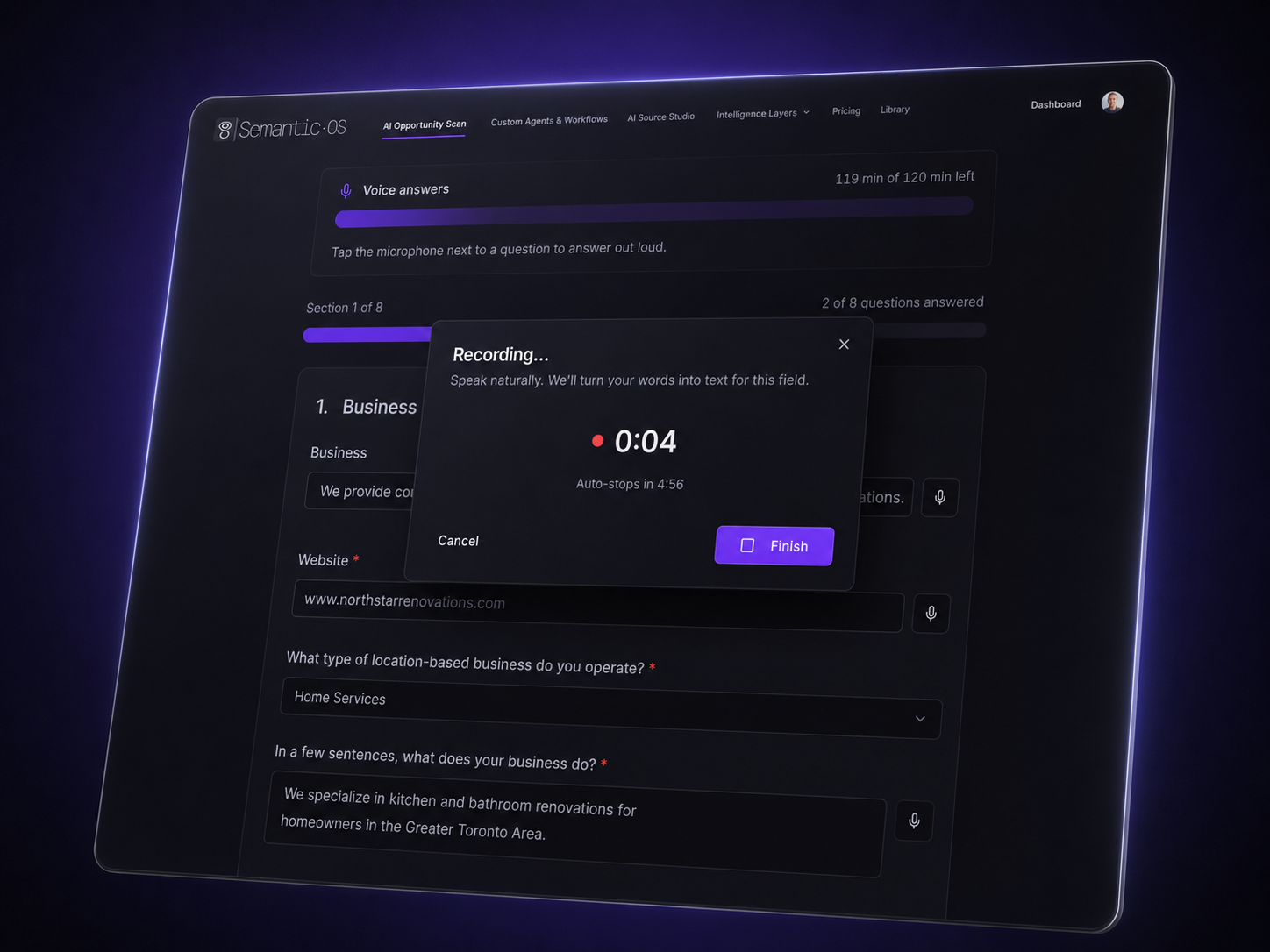
Inside the Structured Intake
Guided questions, voice input, autosave, and the ability to return as you work through the business.
What It Helps Identify
What the AI Opportunity Scan Helps Identify
The scan is designed to understand how your business actually works before recommending next steps. It looks at your workflows, bottlenecks, systems, team habits, source material, customer experience, sales process, reporting needs, and operational friction.
The goal is not to force AI into the business. The goal is to identify where AI may actually create leverage.
Time & Workflow
- where time is being lost
- what work gets repeated often
- manual admin and process bottlenecks
Sales & Customer Experience
- where customer follow-up breaks down
- customer service friction points
- where reporting or visibility is weaker than it should be
Source Material & Readiness
- where information is scattered across tools, people, or documents
- where decisions depend on manual review or tribal knowledge
- where source material needs organizing before AI can help
AI Opportunity
- where a custom agent, workflow, dashboard, or intelligence layer may make sense
- which ideas should be explored first
- which ideas should wait
The Cost of Confusion
What Could Unclear AI Effort Be Costing?
A few hours a week of unclear AI effort can quietly turn into thousands of dollars in internal time before software, contractors, or implementation costs are even added.
5 hrs/week
Researching tools, testing automations, rewriting AI outputs, and debating where to start
260 hrs/year
Of unclear AI effort across the team
$19,500
In internal time at a $75/hour blended cost
The Clarity Point
$500
One-time AI Opportunity Scan to create a clearer starting point
The cost of AI confusion is not only the software subscription. It is the time spent researching tools, testing disconnected ideas, rewriting poor outputs, discussing possibilities without a plan, and trying to decide what to build next.
The AI Opportunity Scan is a low-cost way to create a clearer starting point before larger AI spending begins.
This example is illustrative. Actual time and cost depend on the business, team size, labor costs, workflows, and implementation decisions.
How It Works
How the AI Opportunity Scan Works
Complete the Deep Intake
Answer structured questions about your business, workflows, tools, bottlenecks, source material, goals, team context, customer experience, and current AI ideas.
We Conduct an Internal Review
Semantic OS reviews your intake before the session to identify patterns, opportunities, readiness gaps, workflow friction, source-material issues, and places where AI may or may not fit.
Join the 60-Minute Opportunity Session
We walk through the key findings together, clarify anything important, pressure-test the strongest opportunities, and discuss what makes sense next for the business.
Receive the Written Follow-Up Plan
After the session, you receive a written plan summarizing the strongest AI opportunities, what should wait, where the business may need better structure first, and the recommended next steps.
Sample Questions
A Few Things We Look At
The scan is designed to understand how your business actually works before recommending where AI may fit. Example questions include:
Where does your team lose time?
What work gets repeated often?
What information is scattered across tools, documents, people, or systems?
Where does work slow down because context is missing?
What customer follow-up, sales, service, or admin work depends on manual effort?
What decisions depend on manual review or tribal knowledge?
What would become easier if the source material were better organized?
Where could AI help people move faster without removing human judgment?
Want the deeper product explanation? Learn more about the AI Opportunity Scan.
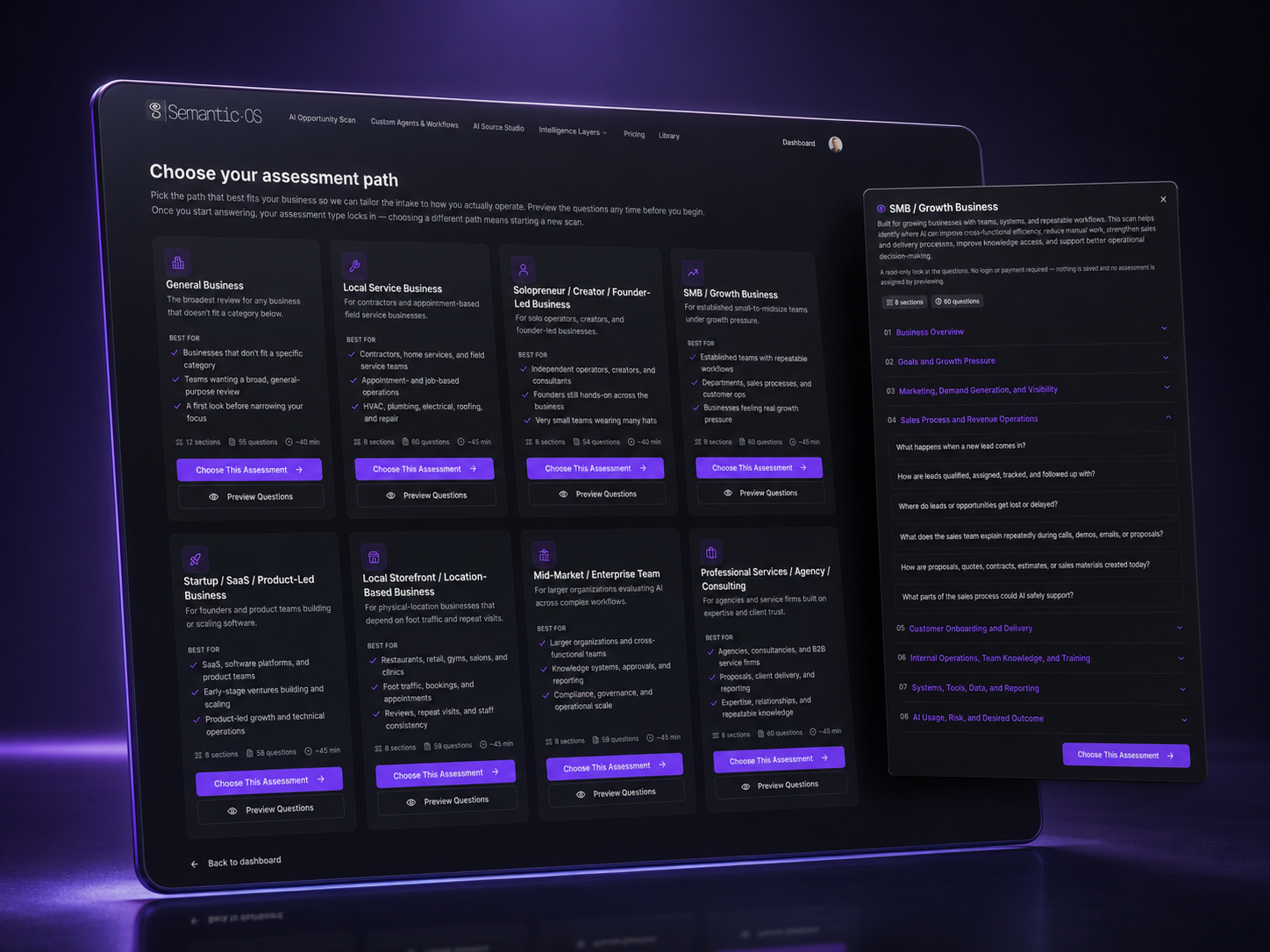
A structured, specific intake — not a generic consulting call.
Sample Deliverable
See How Your AI Opportunity Plan Is Structured
The sample shows the structure of the deliverable. Your scan shows the actual opportunities, priorities, readiness gaps, and next steps based on your business.
Sample is for demonstration purposes and does not represent a real client report.
What You Walk Away With
You Walk Away With a Practical AI Opportunity Map
The scan is not a vague AI brainstorming session. It is a structured review that helps turn your business context into a clearer set of possible next steps.
written opportunity summary
prioritized recommendations
readiness notes
workflow observations
source-material observations
possible next-step paths
human-reviewed guidance
60-minute review conversation
A sample of the structured opportunity plan you receive — your scan reflects your business.
The goal is to help you understand what may be worth doing next, what may need to be cleaned up first, and what should not become an AI project yet.
Low Risk
Not clear after the process? You are covered.
The Clarity Guarantee
If you complete the intake, attend the review, and still do not feel the scan gave you clearer direction on where AI may fit inside your business, we will refund the scan fee.
Before You Buy Another AI Tool, Find the Real Opportunity First.
AI can absolutely create value for small businesses. The expensive mistake is moving into tools, automations, agents, dashboards, workflows, or custom systems before the right opportunity is clear.
Start with a structured, human-reviewed AI Opportunity Scan and walk away with a clearer plan for where AI may actually fit inside your business.
Sources & Research Referenced
This page references AI adoption, implementation, productivity, and business-value research from McKinsey, BCG, and OpenAI. These sources are used for general market context only and do not imply endorsement of Semantic OS or the AI Opportunity Scan. Any time or cost examples shown are illustrative and depend on the business, team, workflows, labor costs, and implementation decisions.